by Christopher | Aug 7, 2026 | Uncategorized
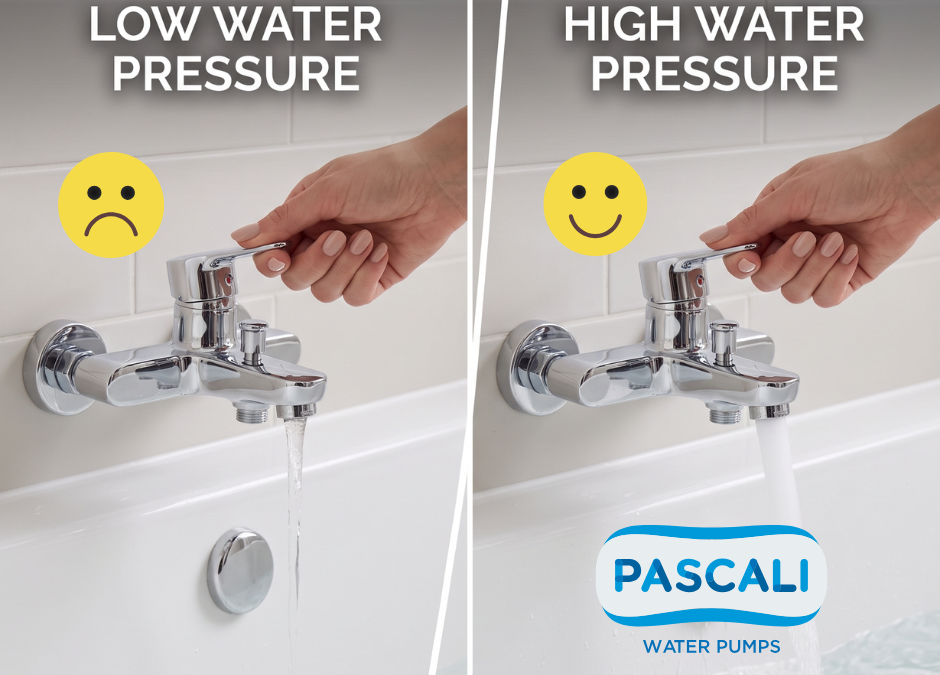
There’s nothing quite like standing under a trickle instead of a shower, or waiting three minutes for the sink to fill. Low water pressure is one of the most common complaints South African homeowners raise — and one of the most misunderstood. It’s rarely one single thing. It’s usually one of a handful of specific, diagnosable causes, each with its own fix.
Before you call a plumber (or blame the municipality), work through this list. We’ve matched each cause to the type of pump that actually solves it — and been upfront about the ones a pump can’t fix on its own.
1. Your municipal supply pressure is naturally low
Municipal water pressure in South Africa varies enormously by area, and it drops further during peak usage times — early mornings and evenings, when everyone on your street is showering, cooking, or watering the garden at once. If you’re at the end of a long supply line, on a hill, or in an area with ageing infrastructure, you may simply never get strong pressure from the mains alone.
The fix: A booster pump installed on your incoming line raises pressure to a consistent level regardless of what the municipality is delivering. A Pascali peripheral pump with pressure switch(PASQB60SK, 0.37kW) is a compact, affordable option for smaller homes with one or two bathrooms. For larger households or multiple simultaneous outlets, step up to a Pascali centrifugal pump such as the 0.75kW or 1.1kW range, which delivers more volume without losing pressure under load. See the full centrifugal pump range here.
2. You’re relying on a JoJo tank or rainwater harvesting system without a booster
Gravity alone rarely delivers usable household pressure from a tank. Even a tank raised on a stand only produces a modest amount of pressure per metre of height — nowhere near what a pressurised municipal line provides. If your home runs off stored or harvested rainwater and nothing is boosting it, low pressure is expected, not a fault.
The fix: A self-priming jet pump (Pascali PASJET100, 0.75kW) is purpose-built for exactly this — drawing water up from a tank below the pump and delivering it under pressure to the house. If the tank sits some distance from the house, or below ground level, the jet pump’s self-priming design copes far better than a standard centrifugal pump, which needs to stay flooded to keep working.
3. Your borehole pump is undersized or mismatched to the borehole
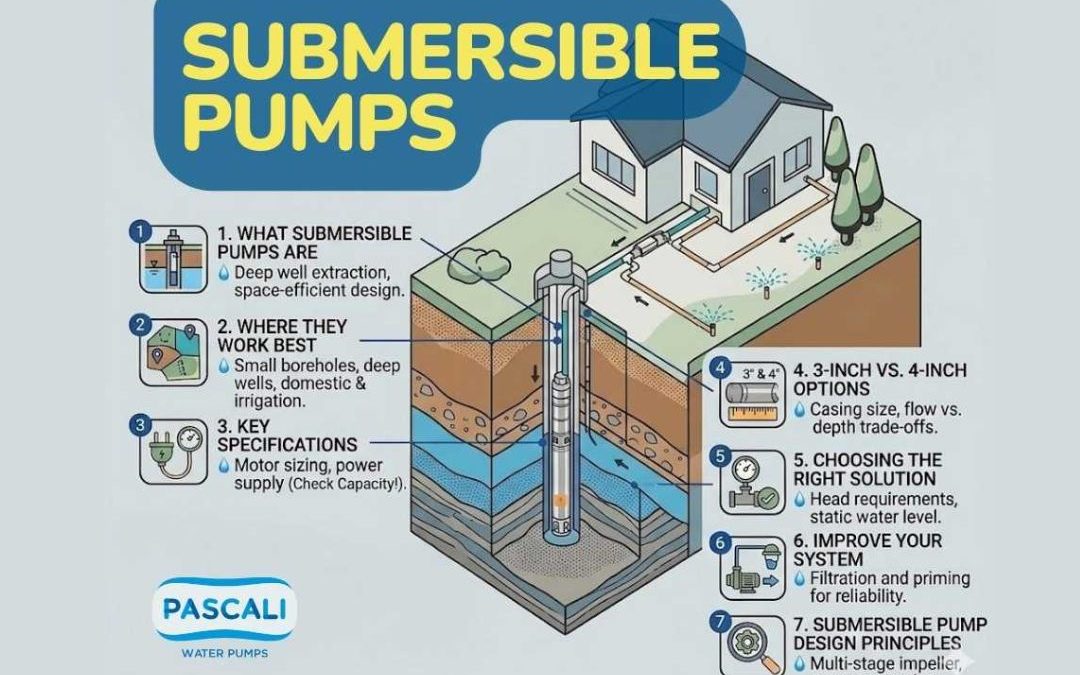
This is one of the most common — and most expensive to get wrong — causes. A submersible pump that’s too small for the borehole’s depth and yield will underperform no matter how well it’s installed. Equally, a mismatched motor and pump end (wrong kW pairing) can cause poor pressure even when the borehole itself has plenty of water to give.
The fix: Borehole pressure problems need correct sizing, not just a stronger pump. Pascali’s submersible range is built modularly — a 100mm or 3-inch motor paired with a matching wet end of the same kW rating — so the combination can be sized to the borehole’s actual depth and yield. For most households, a Pascali Submersible Pump Combo (0.37kW, 0.55kW, or 0.75kW, factory pre-matched) removes the guesswork entirely. Deeper or higher-yield boreholes should move up to the 0.92kW–2.2kW individually matched submersible motor and submersible wet-end range. Confirm your borehole’s depth, static water level, and required flow before choosing — this is the single most important step in fixing borehole pressure issues.
4. You live on an upper floor, or in a double- or multi-storey building
This one catches people out because it has nothing to do with how many taps are open — a single shower on the top floor of a double-storey house or a block of flats can still run weak, purely because of height. Water pressure drops by roughly 0.1 bar for every metre it has to be lifted vertically, so the second floor of a home, or a third-floor apartment, is working with meaningfully less pressure than the ground floor is fed with — even from an identical municipal supply. Add multiple bathrooms or appliances running at once on top of that, and the drop compounds further: if pressure is fine with one tap open but collapses the moment a second shower or the washing machine kicks in, both height and simultaneous demand are likely at play together.
The fix: The pump needs to be sized to overcome the building’s height (its “head”) plus deliver normal working pressure on top of that — not just matched to the municipal supply at ground level. A Pascali 1.1kW or 1.5kW centrifugal pump handles the added height and several open outlets without the pressure drop a smaller pump would show. For multi-storey homes or flats that want genuinely constant pressure at every floor regardless of how many taps are open, the Pascali Variable-Frequency Pump (PASVFG204/PASVFG404 — see Pascali’s range on Agrinet for current availability) is worth considering: it continuously adjusts motor speed to match real-time demand, holding pressure stable from the ground floor to the top floor, and uses meaningfully less electricity than a fixed-speed pump doing the same job.
5. Load shedding keeps knocking your pump offline — and it won’t reprime
Every time the power cuts, some pump types lose their prime and need to be manually bled or restarted once electricity returns. If you’re finding that pressure is fine right after a power cut but degrades or disappears over the following hours, an airlock or lost prime is often the reason — and it’s a particularly common load-shedding-era complaint in South Africa.
The fix: A self-priming jet pump is specifically designed to recover its own prime after a power interruption, without needing to be manually topped up or bled. If your current setup requires you to reprime it by hand every time the power comes back, that’s a strong sign your pump type doesn’t suit a load-shedding environment — and switching to a self-priming design solves the problem at the source.
6. Old, scaled, or corroded pipes are restricting flow
Here’s the one a pump can’t fix. Galvanised steel pipes in particular narrow over time as mineral deposits and rust build up on the inside walls, restricting flow even when the pump and municipal supply are both working perfectly. If your home is older, and pressure has been getting gradually worse over years rather than suddenly, this is a strong suspect.
The fix: This needs a plumber’s inspection, not a bigger pump — installing a stronger pump upstream of a narrowed pipe just pushes water harder into the same bottleneck, wasting energy and adding wear without improving pressure. A Pascali pressure gauge (0–1200kPa) fitted at different points in the system can help a plumber pinpoint exactly where the drop is happening, which speeds up diagnosis considerably.
7. There’s a leak somewhere in the system
A slow leak — in an underground pipe, inside a wall, or at a fitting — can quietly bleed off pressure before it ever reaches your taps. This is easy to miss because there’s often no visible water, especially with underground leaks.
The fix: Again, not a pump problem. If your municipal meter keeps ticking over when every tap in the house is closed, you have a leak, full stop — no pump upgrade will compensate for water going missing before it reaches the house. Fix the leak first; only then reassess whether pressure is still low enough to need a booster.
Getting the diagnosis right before you buy
The costliest mistake in fixing low water pressure is guessing. Buying a bigger pump when the real issue is a leak or a scaled pipe wastes money and doesn’t solve the problem; under-sizing a borehole pump means disappointing pressure no matter how good the borehole is. If you’re not sure which of these seven causes applies to your home, start with the simplest checks — is it isolated to one tap, one time of day, or the whole house all the time? — before deciding which type of pump, if any, is the answer.
Pascali’s range covers every stage of this: peripheral and jet pumps for municipal boosting and tank supply, centrifugal pumps for multi-outlet households and multi-storey homes, the Variable-Frequency Pump for constant pressure, and a full submersible range for boreholes.
Available from retail partners nationwide, with in-market technical support to help you match the right pump to the actual cause — not just the symptom. For a list of resellers go here: https://pascalipumps.co.za/where-to-shop/

by admin | Oct 25, 2021 | Uncategorized
Like many things in life, a one-size-fits-all-approach doesn’t suit everyone. Your household water pressure and consumption is unique and that is why you need the right tool for the job.
Luckily Pascali’s range of pressure pumps is extensive enough to provide the perfect fit in nearly every situation.
Pascali’s pressure pumps for domestic use can be roughly divided into three categories: self-priming peripheral pumps; jet pumps and centrifugal pumps. The flow and pressure characteristics of each of these pumps will differ slightly and should be matched with your desired results.
Peripheral pump
Peripheral pumps are great all-rounders and Pascali has a 0,37kW and 0,75kW pumps in this range, which can be combined with an electronic flow control or mechanical pressure control mechanism and pressure tank. These cost-effective pumps can deliver more than 3 000 litres per hour, or up to 5 bar of pressure.
Jet pumps
Jet pumps are ideal for garden irrigation or where the water source is slightly below where the pump will be installed. Pascali has two jet pumps on offer, the PASJET100 rated at 0,75kW and the PASSS80 stainless steel jet pump, also rated at 0,75kW. Jet pumps typically have a higher head than other pumps of a similar power rating. The stainless-steel jet pump differs from Pascali’s other pumps in that the impeller is stainless steel instead of brass. Jet pumps can also be combined with an electronic flow control or mechanical pressure control mechanism and pressure tank.
Centrifugal pumps
Centrifugal pumps are the workhorses of the pumping world and in this category Pascali has no fewer than five offerings: 0,37kW; 0,55kW; 0,75kW;1,1kW and 1,5kW. These pumps have a very flat delivery curve and predictable, constant pressure. As with all the above, these pumps can be combined with an electronic flow control or mechanical pressure control mechanism and pressure tank.
All Pascali’s domestic pressure pumps:
- are driven by a single phase 2-pole induction motor with 100% copper windings;
- has capacitor and thermal overload protection;
- the pump bodies are made from sturdy cast iron, (except the stainless-steel jet pump);
- the impellers are solid brass;
- the motor shaft is stainless-steel;
- the mechanical seals are ceramic-graphite;
- and the motor support mounts are made from aluminium.
To choose the right pump for your application, consult the professionals at Pascali, who are standing by to answer all your questions.

by admin | Oct 25, 2021 | Uncategorized
With the countrywide drought and strict water restrictions in the Western Cape and other regions still fresh in our memory, several homeowners have resorted to – or are considering – installing shallow wells to access groundwater close to the surface. This water, if available in your area, is a great resource to supplement or even replace municipal water to irrigate your garden, or as an emergency water supply.
People have been digging wells all over the world for thousands of years and many of the best constructed wells are still in use today.
– What is a shallow well?
A shallow well is typically just a hole in the ground for water to seep into. It differs from a borehole in that it is much shallower and doesn’t attempt to tap into an underground aquifer. These wells can be created in a variety of different ways, depending on your soil type, from digging it with a shovel or excavator to drilling or ramming pipes into the ground. The cost of digging a shallow well is much less than drilling a deep borehole.
Water from these wells will typically have a lower level of total dissolved mineral solids compared to most boreholes, but shallow wells are more prone to bacterial contamination from above and the opening should always be covered for safety.
The sidewalls should also be lined with either plastic or metal piping to prevent it from collapsing.
– How do I get the water out?
Water can be extracted from a shallow well with a jet pump up to a depth of around 6 metres. The pipe going down the well should be as wide in diameter as possible to reduce friction and there must be a spring-loaded non-return valve at the bottom of the pipe to keep the pump primed. The water extracted by the jet pump can be stored in a water tank to use later, or it can be used directly to irrigate your garden.
The size of the jet pump you need will depend on the depth of your well, how fast it recharges, and how far you want to pump the water once it is above ground. The recharge rate of your well is the time it takes to refill with water after pumping all the water out. It is advisable to never let the inlet of your suction pipe hang right at the bottom of the well where it can suck in sand or debris, as this will very quickly wear the pump’s impeller down.
– How do I know if a well will work in my area?
The simplest way to know if a well will work in your area is to ask people in your community if they have a working well. Unfortunately, there is no fail-safe way of predicting exactly where you will find water when you start digging. It depends on the soil type, typography and even the rainfall of the recent past.
Pascali stocks a range of jet pumps suitable for shallow well applications and the technical team at Pascali is ready to answer any questions you may have.

by admin | Oct 25, 2021 | Uncategorized
What is commonly referred to as hard water is water that contains a significant amount of dissolved minerals, especially calcium and magnesium. This isn’t a situation associated with rainwater or municipal water, but borehole water can potentially contain a range of dissolved minerals, depending on the rock formations the water travels through.
– Why is it important?
Hard water can influence pumps, pipes, and fittings in the long run. Calcium carbonate deposits – or lime scale – can build up inside pumps, pipes and fittings over time and restrict the flow of water. In the most extreme cases this buildup can cause a pump’s impeller to become stuck inside the pump casing.
The deposits will mainly be located at warmer surfaces and areas where the flow of water is high. In a pump this is typically around the mechanical seal, at the impeller and around the cooling mantle or stator housing. The problems caused by the deposits include mechanical seal failure, unbalance on the impeller and overheating in the motor.
This should be avoided by opening the pump housing, inspecting, and cleaning the impeller, seals and housing with a wire brush regularly. There are chemicals that can remove the build-up, but it is recommended that a professional do this.
Deposits that have built up inside water pipes will cause a reduction in water pressure because they restrict the flow. Over time, water pressure may slow to a trickle or stop flowing altogether.
Hard water will also have an influence on the efficacy of soap, detergents, and shampoo.
– What can be done about it?
If you are reliant on borehole water for domestic use the water should be tested every year by an accredited water laboratory. These tests will give you an indication of the total dissolved solids, pH, possible E. coli count, and a breakdown of the different minerals in your water. There are different thresholds of acceptable levels of dissolved solids in water for domestic use and for irrigation.
If your water has high levels of dissolved solids, it could be worthwhile to install a filtration system. Filtration systems should always be installed in the water system after a booster pump. The pump should push the water through the filter and not have to suck the water through the filter.
Be aware that if you have hard water, regular mechanical cleaning of the pressure pump is the most practical solution.
For the best possible advice contact the professionals at Pascali who are standing by to answer all your questions.

by admin | Oct 25, 2021 | Uncategorized
You will often see a pressure pump sit on top of a small pressure tank in domestic setups. This tank is not just to keep the pump and motor off the ground but plays an important role in the way your pressure pump system functions.
– How does it work?
Air can be compressed, water cannot. The pressure tank, which is typically 24 litres in capacity stores water and compressed air, separated by a rubber membrane or bladder. The air pressure inside the pressure tank can be adjusted to the desired level at which the system should operate. A pressure tank is usually installed with a mechanical pressure switch, which will switch the pump on if the pressure drops after a tap is open for long enough and will switch off again when a pre-determined pressure is reached.
– What a pressure tank does
When a tap is opened for a short while, like filling a glass of water, the air pressure in the tank will push the water out and the pump won’t have to switch on. If a tap is kept open for longer, like running a bath, the pressure will drop and the pump will switch on to restore the pressure to the pre-set level.
– Benefits of a pressure tank
Some of the benefits of a pressure tank is that your pump won’t have to switch on every single time someone opens a tap. This saves electricity and reduces wear and tear on the pump motor. Another benefit is that there is a larger amount of water that is already under pressure compared to a system without a pressure tank. This pressurised water is available even in the event of a power failure.
Because water cannot compress there is a phenomenon called the water hammer effect. This happens when fast flowing water comes to a sudden stop, like a closed tap. The water crashes into this obstruction with a significant force. There is a massive amount of energy locked up in moving water and the water hammer effect can really cause some damage. The pressure tank with an air compartment serves as a shock absorber, alleviating the hammer effect on your entire system, because the air can be compressed to dissipate the energy.
If you have any more questions or you need a qualified professional to install your pressure pump system, don’t hesitate to contact the technical people of Pascali for assistance.