It can be extremely frustrating having to deal with inadequate water flow and water pressure, but there is something you can do to improve the situation.
Even though water flow (or flow rate) and pressure are two different measurements, they are still related to each other.
Water flow refers to how much water comes out of a tap or other fixtures in a specific time.
Water Pressure refers to the force that the water is under to make it move in the desired direction, or the amount of force the water exerts on the pipe and fittings containing it.
What’s the difference between water pressure and water flow or flow rate?
Water flow is measured in litres per minute, so it has to do with volume over time.
Pressure is measured in bar or PSI (pounds per square inch), so this equation has to do with weight and surface area.
When a tap is closed the flow is zero, but the pressure can be 3 bar for example. As soon as the tap is opened the flow increases and the pressure drops. There is a sweet spot between flow and pressure that is ideal for household applications and various factors influence both. A pressure pump can help homeowners to achieve the desired flow and pressure.
What affects flow and pressure?
Water flow and pressure are both affected by friction. Friction is caused by the inside diameter of the pipe, elbow fittings, height, etc.
As water moves through a pipe, friction will slow it to a certain degree, depending on the texture and diameter of the pipe. The smoother the pipe, the less friction there will be, and the faster water can move through the pipe, provided that the water pressure is sufficient. With good water pressure, the friction in smaller pipes can be overcome so that the water flow remains high.
How do I overcome friction?
A professionally installed water pressure booster pump can help to overcome limiting friction inside a water system.
A water pressure booster pump increases the pressure the water experiences on demand, overcoming friction to be delivered to where it is needed. Because the friction is overcome, higher pressure will also lead to higher flow rates, because both flow and pressure are affected by friction.
(For illustration purposes only)
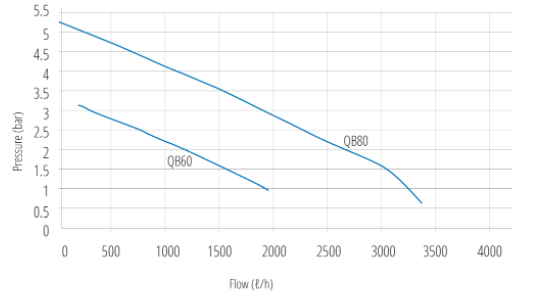
For a visual representation of flow and pressure many pumps will have a flow chart, depicting its characteristics under different circumstances.
Homeowners need to find their sweetspot
Pressure is indicated on the vertical axis and flow on the horizontal axis. As illustrated pressure is highest when the flow is lowest, and vice versa. The sweet spot for household water delivery is a balance between flow and pressure and the pressure booster pump you choose should create this balance.
Check out the interview with Pascali’s technical advisor on this very subject!
Homeowners sometimes experience water pressure problems in their homes or with irrigation systems. There can be many possible causes of low water pressure/flow in your home, and it is a process of elimination before deciding on and investing in a pressure pump system.
If there was a sudden change in your water pressure, there are some checks you can do to determine what the cause of your problem is. Below are a few possible causes:
Your water supplier is having trouble
If you are on a municipal supply and the water pressure is suddenly low, contact your neighbours to find out if they have a similar problem. There may be a burst pipe in the distribution system and water was cut off to do repairs. This should hopefully be resolved quickly and won’t require any input from your side.
The main water shutoff valve is partially closed
If you are the only one in your street experiencing low water pressure, check that the main shutoff valve leading to your property is fully open. A partially opened valve will cause lower flow and pressure in your home.
The pressure regulator may be faulty
Not all plumbing systems have pressure regulators, but if there is one have it checked out by a professional to make sure that it is working properly and is not causing your pressure headache.
Your pipes may be clogged
Water supply pipes can become clogged over years. These obstructions can restrict the waterflow and pressure in the system. This will happen over years of use and won’t become apparent all of a sudden. If you suspect that this may be the case, you need to contact a professional to do an inspection. This will involve turning the water supply off and opening some of the fittings to inspect the inside of the pipes. In the worst-case scenario, you may need to replace all the water pipes in your home, but this will give you the opportunity to upgrade to a larger diameter pipe, which should improve the flow throughout the system.
Pipes may be corroded
If your house is very old the water pipes may be corroded on the inside. Galvanised steel pipes have a lifespan of around 20 years. Copper pipes should last 50 years or more. Modern plastic pipes with brass fittings also have a long life expectancy when it is protected against the elements. Corrosion on the inside of pipes or fittings can restrict the flow of water and decrease the pressure. Have a professional check it out.
You may have a leak
Not all water leaks are obvious. It may be underground or inside a wall. The loss of water through a leak can have an impact on your water pressure and most leaks will only worsen over time, so call a professional if you suspect that there may be a leaking pipe somewhere.
You may have faulty or clogged fixtures
If you have low water pressure in all your plumbing fixtures, the issue is almost definitely with your water supply or your pipes. However, if it’s one or a few fixtures that seem to have a low flow, you may want to check out the fixtures.
Remove any aerators on your low-pressure taps and see if they need cleaning. Once they’re completely clear of any buildup, put them back on and see if this makes a difference in your water pressure.
Regulations in your municipality or city
During the severe drought that affected Cape Town and other cities and towns in recent years, water supply was restricted in the distribution system to reduce the consumption. This is usually a temporary measure, but there are steps you can take to ensure that your household’s water supply is supplemented with rainwater, a borehole or just an emergency supply, boosted by a pressure pump.
After you have eliminated all these possible causes and the water pressure is still not to your liking, the next steps are to measure the flow. Using a measuring jug or bucket that you know the volume of and stopwatch, calculate how much water is delivered by your taps. Time how long it takes to fill your bucket with a fully open tap and calculate the litres per minute. You can do this measurement in the bathtub, kitchen, garden tap etc. and compare the figures you get.
A bathtub should get around 15 litres per minute, a dishwasher needs around 10 litres per minute and a shower around 12 litres per minute. If you want to irrigate your garden, you will have to measure the flow of every sprinkler and multiply it with the number of sprinklers you want to run at once to determine if you have enough pressure.
A household pressure pump can be used in a variety of scenarios where higher pressure is needed.
Examples of water pressure problems a water pressure booster pump can solve:
bringing water from a rainwater harvesting tank
pumping water from an alternative source like a river or pond
pushing water from ground level up multiple levels
feeding water to an appliance with high water needs
increasing the overall pressure in the water system
increasing pressure for garden and veggie patch irrigation.
Check out the interview with Pascali’s technical advisor on this very subject!
Water pressure is something most homeowners don’t even think of, until it is not there! It is the difference between an average and great shower or being able to water your entire garden effectively through your irrigation system.
Then there is also the need to transfer water from one point to another to be useful. Perhaps you harvest rainwater in a tank for your garden; your municipality’s infrastructure is neglected; or you rely on a borehole and/or reservoir on an elevated stand to supply your home with running water. But how to get this water from point A to B?
Luckily there is a product that can help – water pressure pumps! In this article we explore how does water booster pressure pumps work, and what they can be used for.
The ideal water pressure for a refreshing shower or to hose down your bakkie is between 2,5 and 3,5 bar (36 to 50 psi). Unfortunately, due to a variety of factors we don’t always have this kind of pressure in our water pipes.
To give an idea of how significant this pressure requirement is, if you have a water tank ten metres off the ground, this gravity system will give you 1 bar of pressure when all the outlets / taps are closed. This pressure will reduce significantly as soon as an outlet is opened. This is where a water booster pressure pump can greatly improve the water pressure throughout the whole system.
How does a water pressure booster pump work?
A water booster pressure pump is basically a specially designed and manufactured electric fan that uses an impeller to move water along pipes.
Different types of pressure pumps have different impeller designs with different characteristics. All pressure pumps however have an inlet from the water source – usually a tank or reservoir – an outlet that goes to your house or garden, and a sensing device to switch the pump on and off according to preset parameters. This sensing device can be either electronic – measuring the flow of water, or mechanical – measuring the pressure.
The importance of pressure and flow
Flow and pressure are two sides of the same coin. As flow increases, pressure decreases. A pressure tank is often added to the system to provide a reserve of pressurised water, this prevents the pump from kicking in every single time someone opens a tap for smaller quantities of water, like washing hands or filling a glass of water. This extends the life of the pump, reduces wear-and-tear, and prevents needless power consumption.
Water consuming appliances such as washing machines, dishwashers and icemakers also require a minimum water pressure to function correctly. These machines have their own valves to regulate the water flow and often rely on steady, predictable pressure to function correctly. A major washing machine manufacturer recommends that the water pressure shouldn’t be below 1,4 bar (20 psi). Water pressure lower than 1,4 bar can reportedly cause a water valve failure or prevent the water valve from shutting off completely. There is also a fill time limit built into the controls of most washing machines and if the machine doesn’t receive the predetermined amount of water, the wash cycle won’t live up to your expectations.
Remember that to achieve 1,4 bar of pressure with gravity alone will require a tank stand more than 14 metres high!
So in short: A water pressure booster pump pushes water at a faster rate and at a higher pressure than the existing pressure, and switches off automatically when no water is used.
All Pascali’s pumps and motors have stainless steel motor shafts, 100% copper windings, brass impellers and cast-iron or stainless-steel pump bodies to provide many years of hassle-free service.
Hear from our technical expert on this very subject on the informative video below;
No installation is identical, but with the right information in hand, selecting a water pressure booster pump for your home should be straightforward.
Every homeowner has unique challenges when it comes to managing their water-use and pressure. That is why there is a wide variety of water pressure booster pumps available on the market, each to suit a specific need. Deciding which water pressure booster pump will work best in your situation is an important step in the installation journey.
Selecting a water pressure booster pump, especially if it is your first time, can feel daunting, and technical. But armed with the right knowledge, this can be easily overcome.
Below are the important pieces of information you will need to get and consider when deciding on a water pressure booster pump.
DISTANCE: How far will the water have to travel from the source, be it from a rainwater tank, pond or stream?
WATER SOURCE POSITION: Is the water source higher or below where the water pressure booster pump will be installed?
PRESSURE: What is the desired pressure?
VOLUME: What will be the maximum amount of water that might be required?
POWER SUPPLY: How much power will the water pressure booster pump need, as this could affect the size of the cable?
USAGE: What is the water going to be used for? Is it only for household use or do you have a garden to irrigate?
HOUSE DESIGN: Is the house multiple stories high with one, two or more bathrooms?
PIPE SPECIFICATIONS: What is the size of the water pipes already installed in your system?
BUDGET: What is your budget or what are you willing to spend on a pump.
Water Pressure Booster Pumps available from Pascali
The answers to these questions will help you decide on which water pressure booster pump will be best for your situation. A pressure pump specialist will also ask these questions to determine exactly what your needs are.
Domestic water pressure booster pumps range in size from 0,37kW delivering from 1 600 litres per hour – improving the experience in one shower – up to 2,2kW for a large household delivering up to 10 000 litres per hour.
Flow and pressure can be represented in a graph, with pressure measured in bar (or psi) on the vertical axis and flow in litres per hour on the horizontal axis. If you know what your flow and pressure requirements are, these graphs will guide you to make the right choice when it comes to a water pressure booster pump. These graphs can be found with each Pascali pump on this website.
Each specific pump has a unique curve on the graph; some have a higher head with a lower flowrate and others will have a higher flow rate at a lower pressure. Some have steeper curves while others have a flatter curve.
When sizing a water pressure booster pump, rather opt for the larger of two applicable options, because a bigger pump will be less stressed than a pump running at full capacity to meet demand. Should your water need increase in the future, a bigger pump will also be better able to absorb it.
If all this is just still too technical, or your requirements are a bit complex, we recommend getting advice from specialists like the team from Pascali or staff at your local hardware or agricultural retail store.
They will be able to advise you on exactly what will suit your requirements but have all the information above handy for them to make an informed recommendation.
To have a look at Pascali’s technical advisor’s top tips for selecting the best pressure pump for your needs, have a look at this video;
To contact Agrinet, Pascali Pump’s Distributor, please click HERE.
Whatever your household water solution application requirements, there is a Pascali pressure pump for every job!
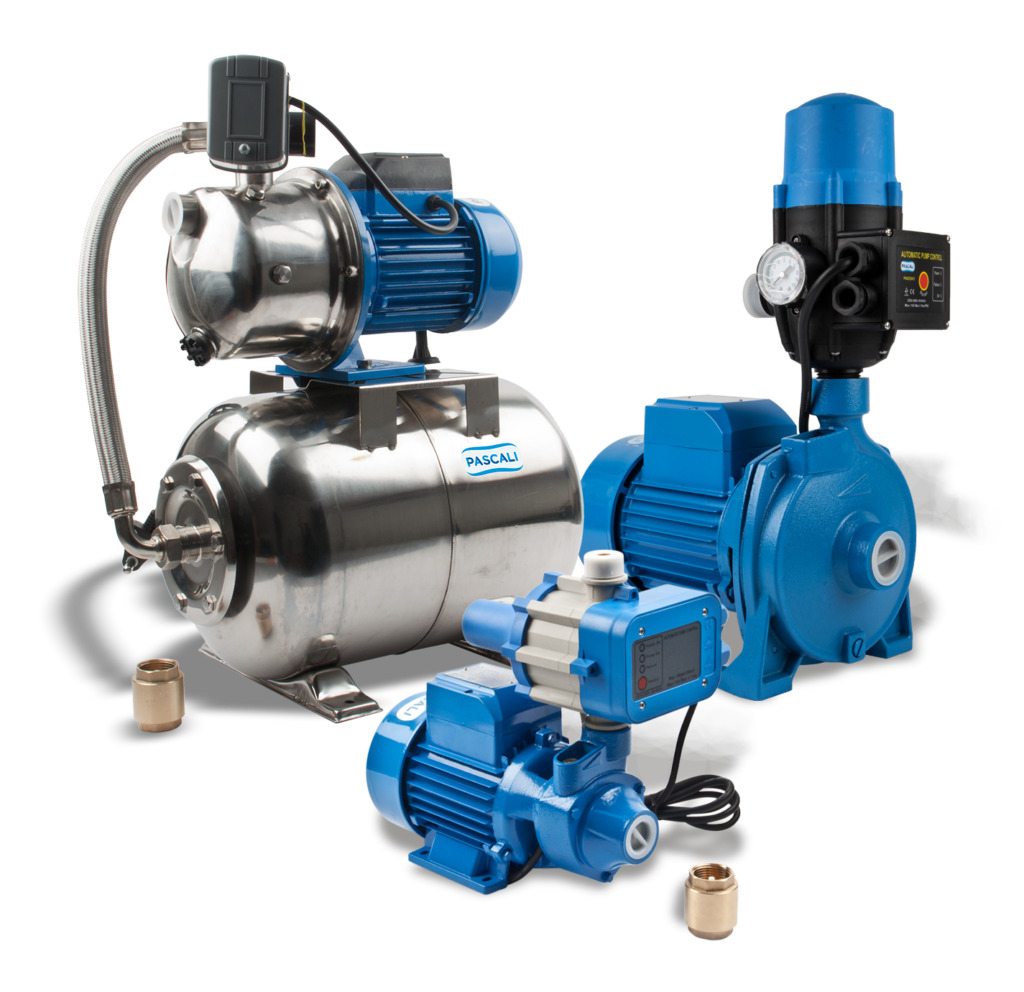
In the range of pressure or booster pumps offered by Pascali there are three main configurations, or different mechanisms by which the pumps operate, namely centrifugal pumps, peripheral pumps, and jet pumps. These categories can be subdivided further, but for simplicity’s sake we are just going to focus on these three and explain their features, and highlights.
Each one of these category pressure or booster pumps, is best suited for a specific use/purpose. The type of pumps selected, depends on the amount of pressure or volume that is required, does the pump need to transfer water uphill or downhill, diameter of the pipe etc.
There are 3 Types of Pressure Pumps or Booster Pumps in the Pascali Range:
Centrifugal Pumps
Peripheral Pumps
Self-Priming Jet Pumps
Centrifugal Pressure Pumps
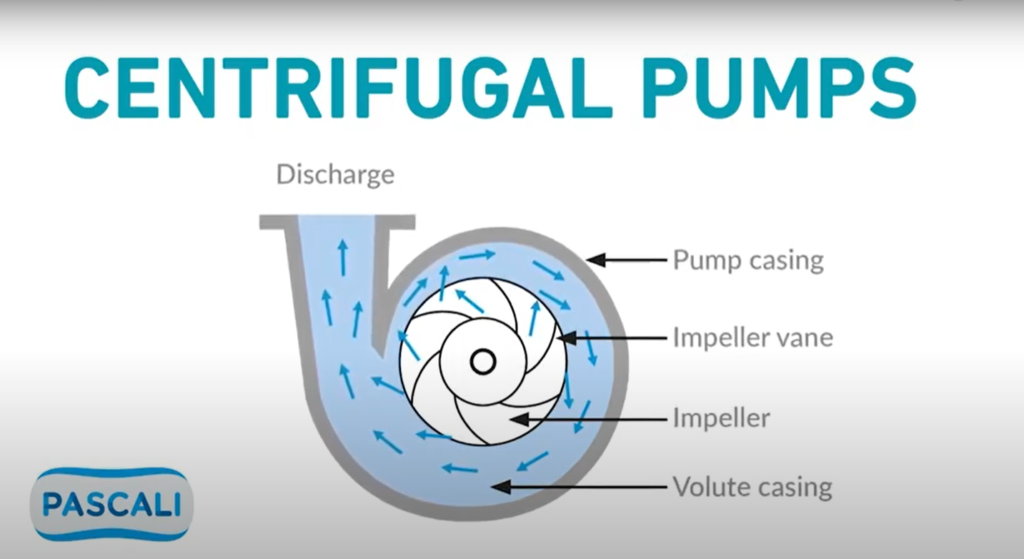
Technical Drawing of a typical Centrifugal Pump
Centrifugal pressure pumps with a single impeller, or set of curved vanes that push the water, are suitable for household, industrial, and civil applications, depending on the size of the pump and the motor.
The electric motor spins the impeller and through centrifugal force the water is flung to the outside of the pump housing and out the outlet with more pressure than it entered the inlet. An easy way to imagine this is the effect of water flicking off a car tyre on a wet road.
Centrifugal pumps have low maintenance costs and are simple to operate. These pumps can only operate when the pump housing is filled with water and should therefore always be installed lower than the water source, such as a tank.
Peripheral Pressure Pumps
Technical Drawing of a typical Peripheral Pump
Peripheral pressure pumps work in a similar way to centrifugal pumps, but the peripheral pump’s impeller is shaped differently and interacts with the water in a different way. Instead of an impeller with curved vanes, a peripheral pump has a solid wheel almost like a grinder disc cutting through a material.
Peripheral pumps are perfectly suited for domestic use. These pumps commonly deliver higher pressure and higher heads compared to centrifugal pumps. These pumps also have a much steeper delivery curve, meaning that as pressure increases, flow volume will decrease. This topic will be discussed in another article.
Another characteristic of peripheral pumps is that, unlike centrifugal pumps, they can pump water with a relatively high air content. These pumps should be installed below the water source. Peripheral pumps are however less efficient than centrifugal pumps.
Self-Priming Jet Pressure Pumps
Technical Drawing of a typical Self-Priming Jet Pump
Self-priming jet pressure pumps are suited to lift water from its source and can be installed above the water source. These pressure pumps are not severely affected by air pockets in the water as centrifugal pumps are. Jet pumps are suitable for domestic use, irrigation or gardens and delivers a high head. It is suitable to lift water for distribution with a low to medium pressure. The configuration of the jet pump is very similar to that of the centrifugal pump, but with the added jet assembly which aids with priming the pump.
If you are unsure of which Pascali pressure pump is best suited for your needs, please refer to the charts with each pressure pump, or consult a professional at your nearest hardware or agricultural retail store.
With Pascali, you can rest assured, you will be getting great quality. All Pascali’s pumps and motors have stainless steel motor shafts, 100% copper windings, brass impellers and cast-iron pump bodies to provide many years of hassle-free service. Each pump is quality & performance tested before it leaves the factory floor.